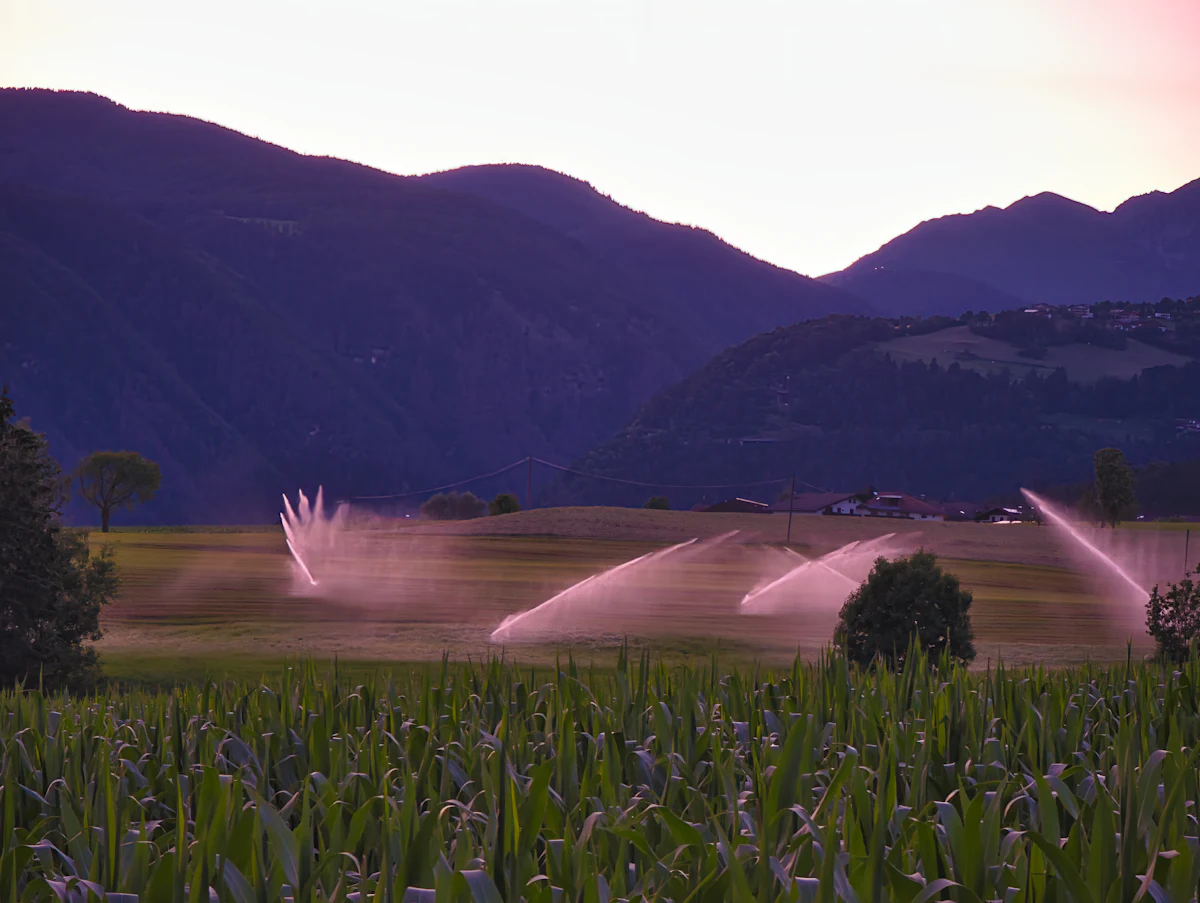
Whether you irrigate from a borehole, dam, river or canal, every application of water leaves something behind in the soil. Over seasons, the wrong water can reduce yields, damage soil structure and clog irrigation systems – often long before the cause is obvious. Testing your water lets you manage the risk before it shows up in your crop.
Why irrigation water quality matters
Poor irrigation water affects your farm in three main ways:
- Crop yield and quality – salts make it harder for plants to take up water, and specific elements can be toxic to sensitive crops.
- Soil health – too much sodium relative to calcium and magnesium breaks down soil structure, causing crusting, poor infiltration and waterlogging.
- Equipment – iron, manganese, hardness and suspended material can clog drippers and micro-sprinklers.
The South African Water Quality Guidelines for Agricultural Water Use: Irrigation (Department of Water Affairs and Forestry, 1996) set out target ranges for these constituents, and are the benchmark our analysis uses.
Salinity: too much salt
Salinity is measured as electrical conductivity (EC) or total dissolved solids (TDS). As water evaporates from the soil and plants take up water, salts are left behind and build up in the root zone. High salinity forces plants to work harder to extract water, which slows growth and reduces yield. Crops differ widely in their tolerance – many vegetables, fruit trees and berries are far more sensitive than crops such as barley or cotton.
Salinity is also seasonal: borehole and dam water often becomes saltier towards the end of the dry season and during droughts, exactly when you irrigate most.
Sodium and SAR explained
The Sodium Adsorption Ratio (SAR) compares the amount of sodium in the water with the amount of calcium and magnesium:
SAR = Na ÷ √((Ca + Mg) ÷ 2) (concentrations in milli-equivalents per litre)
Calcium and magnesium help clay particles stick together into a stable, crumbly structure that lets water and air into the soil. Sodium does the opposite: it makes clay particles disperse. Irrigating with high-SAR water over time can lead to:
- surface crusting and poor seedling emergence,
- slow infiltration, run-off and waterlogging,
- hard, compacted soil that is difficult to work.
The effect of SAR depends on the water’s overall salinity and your soil type – clay soils are more vulnerable than sandy soils. That’s why SAR should always be interpreted together with EC and your soil and crop.
Other problem constituents
- Chloride and sodium – can cause leaf burn, especially under overhead sprinklers on sensitive crops.
- Boron – an essential nutrient at very low levels, but toxic to many crops above a threshold.
- pH – affects nutrient availability and can corrode equipment.
- Iron, manganese and hardness – precipitate and block drip emitters.
When should you test irrigation water?
- Before using a new borehole, dam or river source.
- Before establishing high-value or sensitive crops such as orchards, vineyards, berries or tunnel vegetables.
- Seasonally – ideally at the start and towards the end of the dry season.
- When you notice leaf burn, poor growth, crusting, ponding or blocked drippers.
- If the same water is used for livestock – consider our Livestock Watering test as well.
What our irrigation test covers
Our Agricultural & Irrigation water test assesses the suitability of your water for crop irrigation against the South African Water Quality Guidelines, including salinity-related parameters and the Sodium Adsorption Ratio. Order online, take the sample using our guidelines, and we send a courier to collect it – free, anywhere in South Africa. Our SACNASP-registered specialist can help you interpret the results for your soil and crops.
Protect your soil and your yield
Irrigation water analysis including SAR for R2 710 – with free courier collection of your sample.